
Last week marked the start of the annual UN meeting on women's rights: the Commission on the Status of Women (CSW). Since 1947, this has been the key moment and place where women's rights organisations, women human rights defenders and feminist activists from around the world come together to exchange knowledge, develop strategies and build alliances. They provide input to their government delegations during negotiations, draw attention to specific human rights violations worldwide, and add new issues to the agenda, such as the impact of climate change or discriminatory AI and online hate. But alongside the question of who is present, another question is becoming increasingly pressing this year: who is not?
The United States is becoming an increasingly inaccessible location for global negotiations. Travel restrictions or visa limitations apply to as many as 75 countries worldwide. These are mainly countries in the Global South, particularly in Africa, Latin America, and Asia. For civil society organisations and human rights defenders from those countries, this had very concrete consequences: they simply cannot travel to the United States. Those who cannot enter the country cannot participate. And those who cannot participate are unlikely to be heard. This inevitably affects which perspectives are clearly represented and which are absent. It influences which stories are told and heard, and which are not. It also shapes who helps determine the priorities and direction of the discussion, and who does not.
Even before my departure, several Dutch organisations within the WO=MEN network told me that many of their partners in the Global South had not received visas this year Working directly with those partners is often a key reason for their presence in New York. At the same time, global funding for gender equality and the organisations working on these issues is declining. As a result, many organisations have also been forced to make difficult financial decisions about whether they can attend.
Personal safety also presents a barrier. For trans and non-binary people, the United Stated is virtually inaccessible (see also this blog). The US does not recognise passports with an X gender marker and only accepts travel documents that list "sex at birth”. This means that trans and non-binary people either cannot travel to the US or face a significant risk of discriminatory scrutiny, creating a major barrier to traveling in the first place.
For people of colour, travelling to the US can also involve difficult considerations about personal safety. Others hesitated because of their public profile, as travelers are now required to provide all their social media accounts to US authorities. In recent months I have spoken with several people who ultimately decided not to attend. I also met many who did travel but were concerned about doing so beforehand.
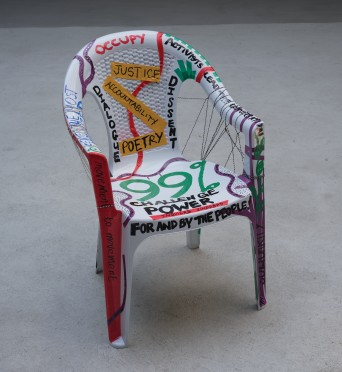
Fortunately, many civil society sessions explicitly acknowledge those who were unable to attend. Because those who are not present are, quite literally, invisible and unheard. Sometimes a video message is shared from a speaker who was unable to obtain a visa. At other times, an empty chair is placed on the stage, as a quiet but visible reminder that someone should have been sitting there.
As one courageous activist said during a session:
"I have spent my entire life arguing against ‘onbehalfism’, but I fear that it is now the best we have. It is up to all of us to speak on behalf of everyone who cannot be physically present here. I hope this will be the last year that CSW is held in the United Stated, because if we want to build a global movement for gender equality, it cannot happen in a place where the world cannot enter.”
Visibility is often crucial for activists who carry out their work bravely and at great personal risk. We know that international attention can provide protection when the world is watching and engaged with their wellbeing. That is why it is important that those who are able to travel are present, to make the work and stories of others visible.
At the same time, many regular CSW participants note that the forum risks becoming less relevant when so many people and perspectives are missing. This is particularly concerning at a time when multilateral decision-making is under pressure, and conservative and anti-gender movements are well organised and present. Precisely now, a strong, visible and organised feminist civil society presence in the negotiations may be more important than ever. If only to keep pointing at the empty chairs, and to continue advocating for the perspectives that are not being heard.
The above photo is from the EmptyChairs campaign. Photographer: Gregor Brändli