
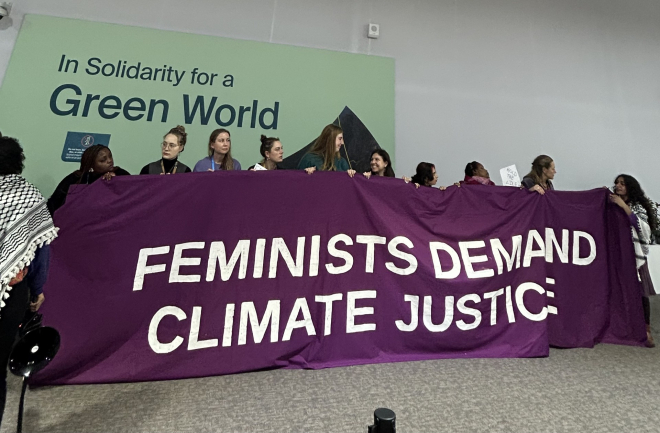
With determination and a feminist approach WO=MEN, together with members ActionAid Netherlands, Both ENDS, CARE Netherlands, de Jonge Klimaatbeweging, Mama Cash, Mercy Corps, Milieudefensie, Mondiaal FNV, New Women Connectors, Oxfam Novib and Women Engage for a Common Future (WECF), will travel this Saturday to the COP30 climate summit in Belém, Brazil. Together, we will advocate across the various climate negotiations for placing gender equality at the centre.
The climate crisis does not affect everyone equally. Women and girls in all their diversity, especially in the Global South, bear the heaviest burdens of the climate crisis despite contributing the least to it. The figures are alarming: in the worst‑case scenario, an additional 158 million women and girls will fall into poverty by mid‑century due to the climate crisis. In comparison, the number of men and boys in poverty is projected to decrease by 16 million (UN Women, 2023).
This disparity is no coincidence, but the result of deeply rooted structural inequalities. Women and girls still often lack adequate access to financing to carry out their climate actions. They are also underrepresented in the spaces where political decisions on climate and biodiversity policy are made, and where they are present, their contributions are frequently ignored or undervalued.
This is not only unjust, it is unwise. Women, particularly in the Global South, play a crucial role in addressing the climate crisis and protecting biodiversity. They hold valuable knowledge on climate resilience and are key actors in sectors such as forestry and agriculture. These insights are essential for sustainable climate solutions. Research shows that when women participate equally in decision‑making, climate policy becomes more sustainable and more just. Women are also often at the forefront of resistance against fossil fuel projects and ecosystem destruction. The same is true for other groups in vulnerable positions, including Indigenous Peoples, LGBTIQ communities and people living in poverty.
Urgent action is needed to ensure inclusive climate policy. It is therefore essential that countries adopt an ambitious new Gender Action Plan (GAP) at COP30. This plan must ensure that gender equality is embedded at the heart of climate policy and climate action. The success of the GAP depends on an approach that is coherent, attentive to intersecting inequalities, and capable of delivering real impact. With the GAP negotiations in mind, we highlight four key priorities for the Netherlands and the European Union.
Read here our GAP recommendations, developed together with the Women and Gender Constituency, for governments worldwide.
In addition to following various negotiation tracks — including adaptation, mitigation, finance and the Gender Action Plan — several member organisations will also host a series of side events on gender and climate.
Are you attending COP as well? Then do come along to the events organised by our members. You can find the full agenda here.