16-04-2026
10 April, The Hague
What does a single mother in Groningen who lives in energy poverty and cannot pay her energy bills have in common with a young woman in the Northern Cape of South Africa who lives next to a mine and suffers from health problems? And how do we ensure that both can participate fully in the energy transition?
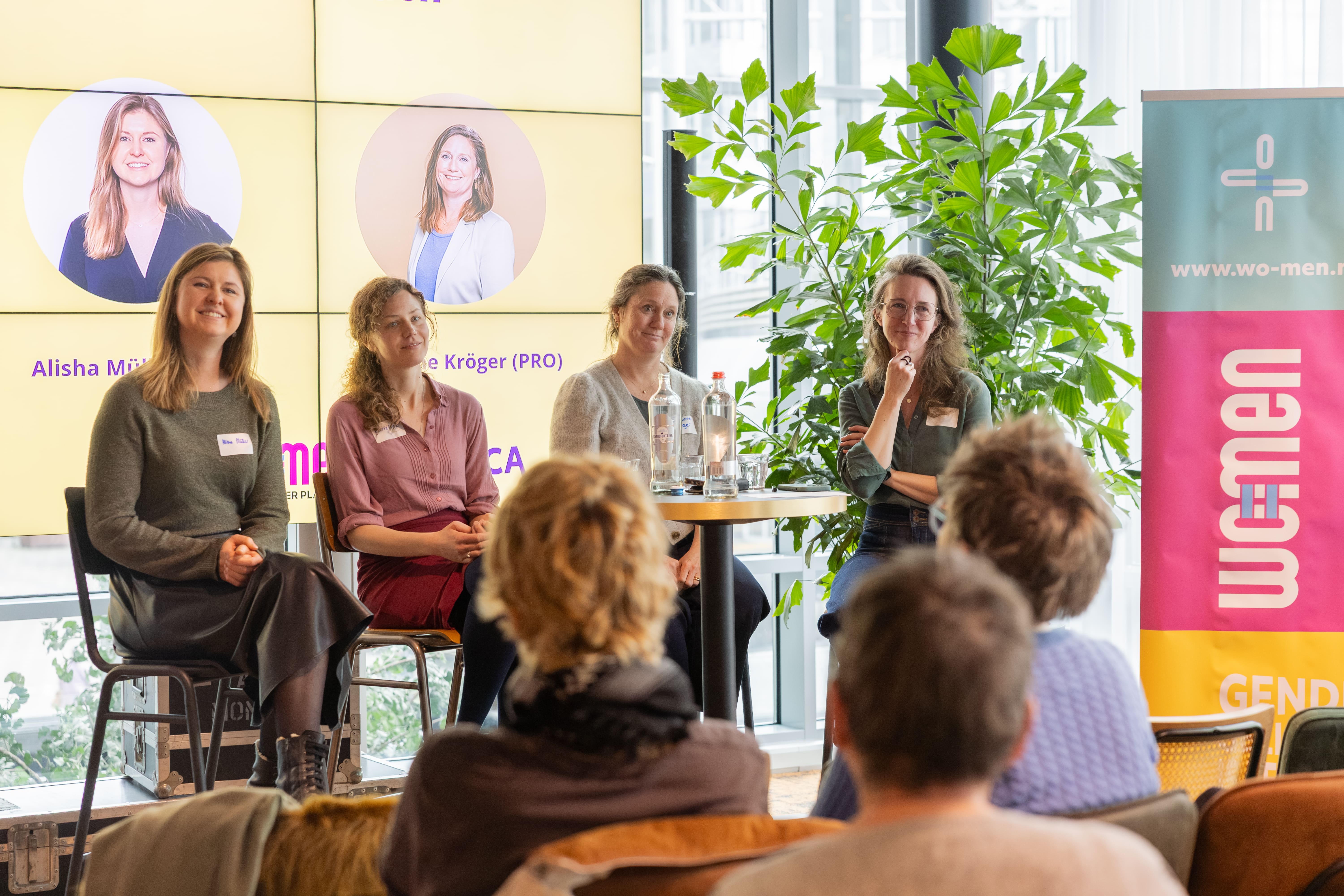
Members of the Dutch House of Representatives Alisha Müller (VVD), Christine Teunissen (Party for the Animals), and Suzanne Kröger (Progressive Netherlands) discussed the role of women in the energy transition during the conference "Gender Equality as a Driving Force for the Green Transition” on 10 April. One thing became clear: the link between gender and energy is still largely overlooked in Dutch politics, but there are many opportunities to start working on it.
Members of Parliament in conversation
Under the moderation of Anne-Floor Dekker, director of WO=MEN, Members of Parliament from the Liberal Democrats, Progressive Netherlands and the Party for the Animals engaged in conversation.
"Gender equality within the energy transition is barely a topic on the political agenda. While the disproportionate impact of climate change on women and girls is increasingly receiving attention in international debates, that same gender dimension in the local energy transition is completely out of the picture,” says Suzanne Kröger (PRO). "But if we want those transitions to succeed, they must be locally supported and close to people. That means women who are directly affected must be able to participate in decision-making, and we need to put more trust in local initiatives. This is necessary for a resilient society.”
Christine Teunissen (PvdD) puts it clearly: "The climate crisis worsens the social inequality we already see. Social inequality still exists, and we have even taken steps backwards. Women's rights are under more pressure than ever. This is the result of political choices. A cultural shift in the energy transition is crucial. The transition is still based on extraction. Which perpetuates inequality. We need to use less. That leads to an equal society."
Alisha Müller (VVD) points out: "One of the problems in the energy crisis is that women's economic independence is so much lower. We need to look at why that is. We want more women in the workforce, and therefore we need to properly organise the enabling conditions for women to work. She confirms topic is rarely discussed: "Even during last week's roundtable on affordable energy bills, gender was not mentioned once." This is striking, given that approximately 80% of people living in energy poverty are women.
Drawing on her experience at the Ministry of Defence, also a traditionally male-dominated sector, Müller argues that to make the energy sector more attractive for women, training programmes must be suitable and workplace accessibility must be taken into account. "A change in company culture is needed, from both the bottom up and the top down," the MP states.
Alisha Müller, Christine Teunissen, Suzanne Kröger and Anne-Floor Dekker. Photographer: Nina Akollo.
The global impact of the energy transition
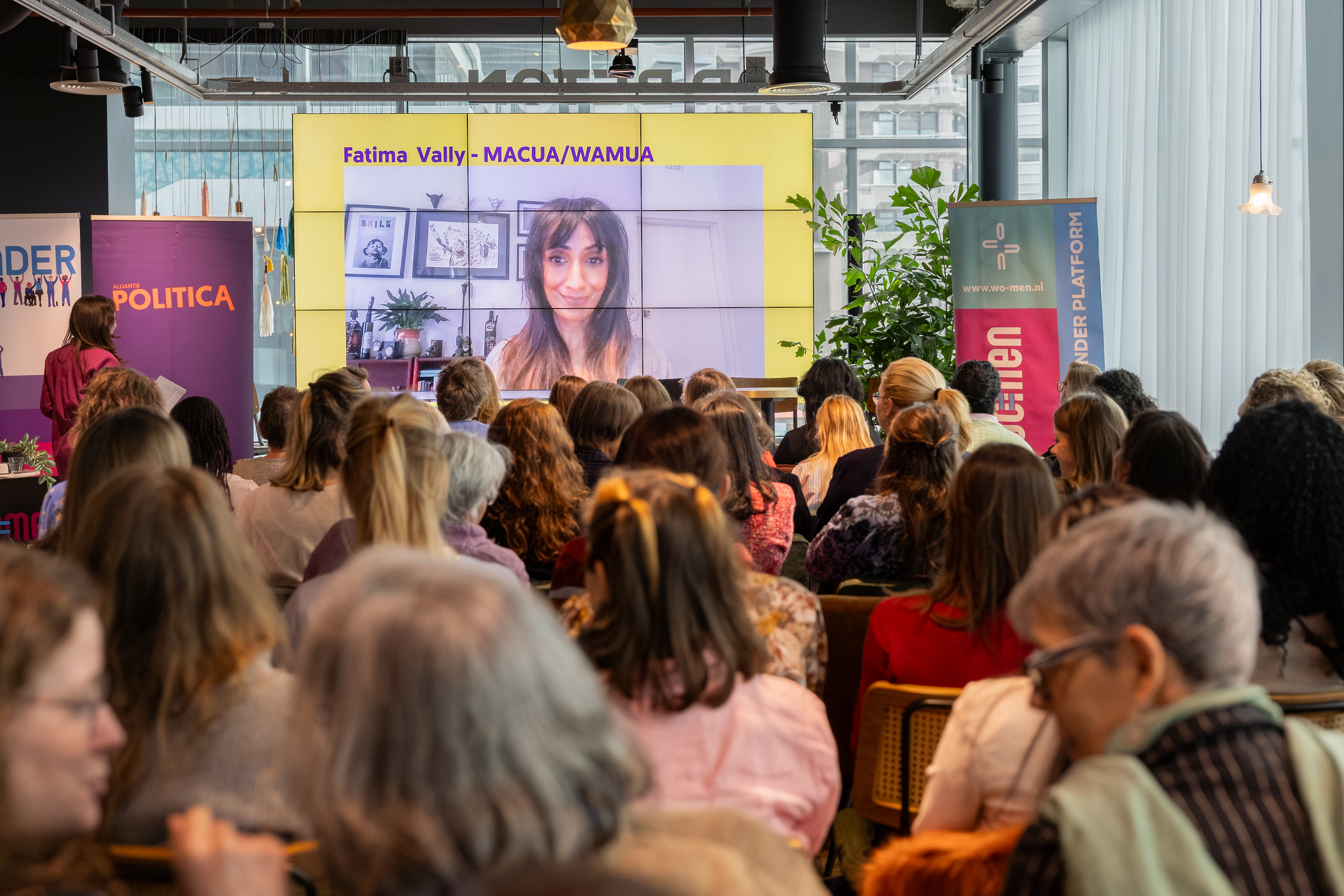
During the conference, Fatima Vally, Programme Director at
MACUA-WAMUA, shared her expertise on the challenges and opportunities that mining in South Africa presents for the global energy transition. The mining sector makes a significant contribution to South Africa's national economy, but this comes with a major downside: it operates through a model that perpetuates human rights violations, increases the marginalisation of communities, and sustains patriarchal violence. MACUA-WAMUA documents abuses linked to the extractions of various critical minerals needed for the energy transition.
South Africa holds the largest share of the world’s manganese reserves, mainly located in the Northern Cape province, which is plagued by deep poverty, unemployment and limited access to social services. Women are the most severely affected by mining activities: they often lack access to clean water, face health risks due to pollution, and take on unpaid care work as illnesses increase or services collapse. Fatima Vally calls on the Netherlands and the EU, among others, to take a leading role in promoting a legally binding international treaty on business and human rights.
She concludes her speech with a powerful message from South Africa: "We can and must transition to renewable energy. But if that transition repeats the same extractive structures, there is no real transition. A just transition must be shaped by the people, for the people and with the people. Not led by corporations, not exclusively by governments, and certainly not driven by the Global North."
Fatima Vally (MACUA/WAMUA) speaking during the congres. Photographer: Nina Akollo.
Barriers and opportunities for the transition in the Netherlands
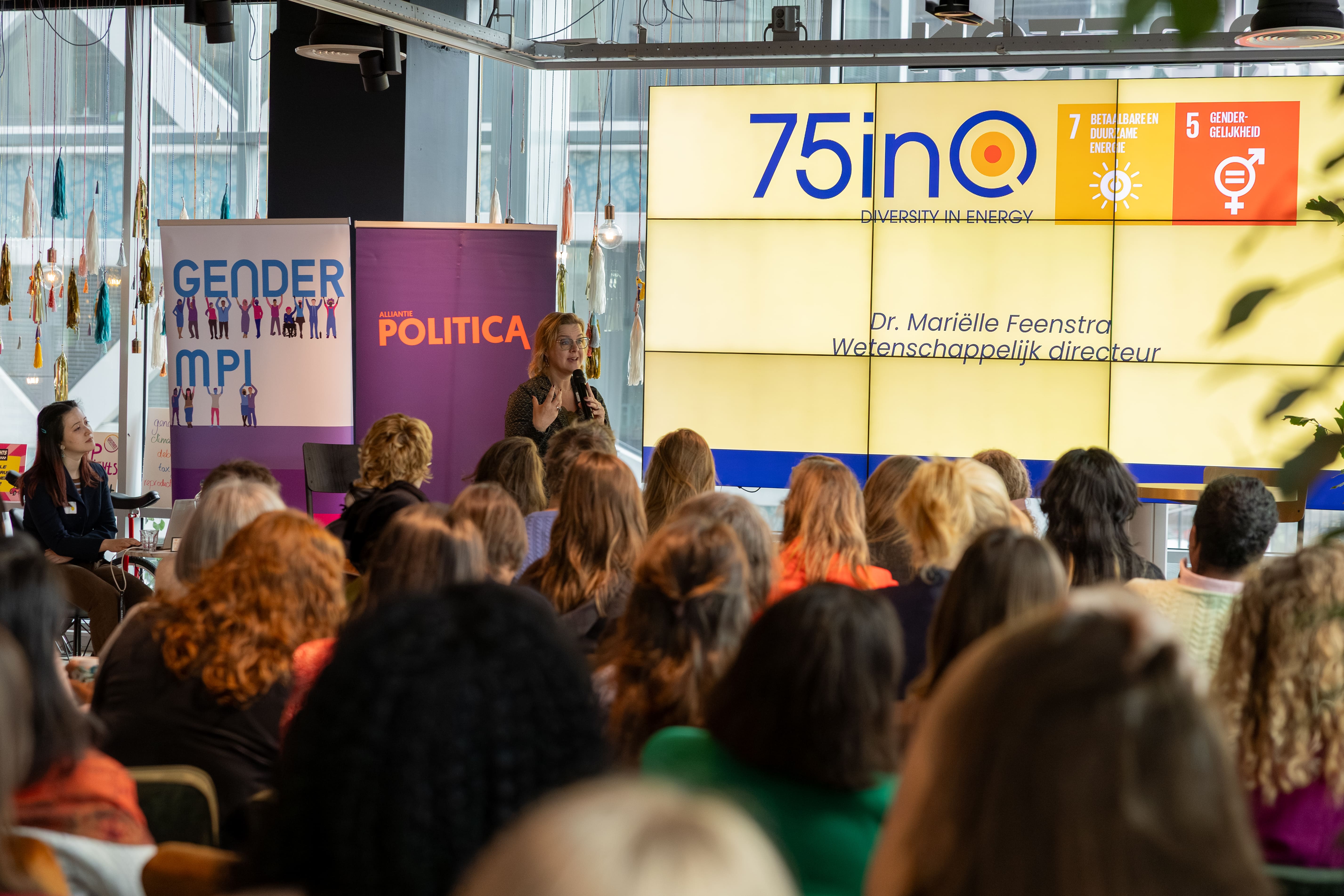
Dr. Mariëlle Feenstra, co-founder and scientific director of
75InQ, is one of the pioneers who has put this topic on the agenda and has conducted research on gender equality and the energy transition for many years. She outlines the challenges, obstacles and opportunities: "There are many roles in the energy sector, from consumer to decision-maker. When we apply a gender lens, we see that men dominate. That does not help an energy transition in which everyone must participate. There is no one-size-fits-all."
Currently, around 70% of people living in energy poverty are women. This determines whether someone can afford to heat their home or must live in a cold house everyday. Causes include income inequality and the unequal division of care work. At present, 96% of decision-makers are men, while they represent only 50% of energy consumers.
Mariëlle Feenstra concludes that to achieve an energy transition for everyone, politics must focus on holistic energy justice. This requires inclusiveness and diversity in all parts of the energy chain, all roles, and all communities. A key step towards an inclusive energy transition is ensuring that women are also present at decision-making tables. If we want policy to be effective - and to do justice to the 50% of energy users who are women - their experiences and needs must be fully integrated into decision-making processes.
Dr. Mariëlle Feenstra of 75inQ. Photographer: Nina Akollo.
The energy transition affects everyone
The diversity of organisations and participants at the conference demonstrated that the energy transition touches many issues and affects everyone. The audience consisted of a mix of civil servants, civil society organizations, and companies. In their workshop, the Youth Climate Movement, CARE Nederland and WECF showed how the energy transition affects everyone, but not in the same way. In addition to gender, also age and place of birth too often determine whether someone benefits from the transition. Both ENDS highlighted grassroots, women-led climate solutions in the Global South and showed how outdated trade rules often block smart solutions. Finally, the workshop "In the Heat of Inequality", led by Mondiaal FNV and New Women Connectors, explored in greater depth the position of migrants and workers in energy supply chains.
Interested or have questions? Contact programme manager Gender and Sustainable Economy Marjolein Quist: m.quist@wo-men.nl or project lead Gender and Climate Eva Colombo: e.colombo@wo-men.nl