12-06-2025
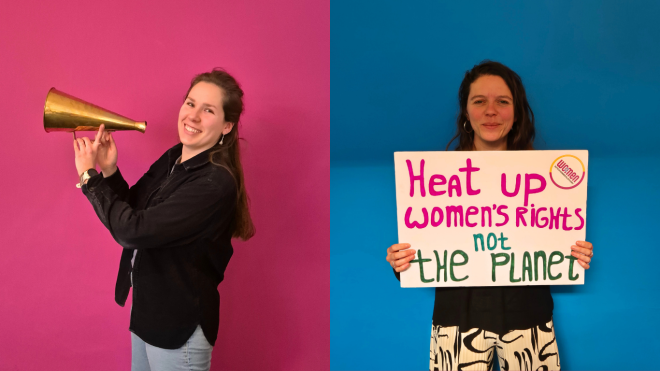
Our Gender and Climate colleagues Eva Lia Colombo & Cléo Dorel-Watson will be present next week at the climate negotiations in Bonn, together with ActionAid Netherlands, CARE Netherlands, Mercy Corps, Milieudefensie, Simavi, Oxfam Novib, WECF, and partners. They will closely follow
the climate negotiations through a feminist lens.
The climate crisis disproportionately affects women and girls
Women and girls in all their diversity are disproportionately affected by the impacts of the climate crisis. This is equally the case for the LGBTQIA+ community, people with disabilities, Indigenous Peoples, and other groups in marginalised positions. Despite their knowledge, expertise, and leadership, these groups are still too often excluded from decision‑making and lack sufficient access to funding and resources to contribute to solutions. This is not only unfair, but also inefficient. Women‑led, feminist and women’s rights organisations play a crucial role in developing and implementing effective climate action. You can find more concrete examples in our paper
‘Fair, Sustainable and Effective. Gender Equality as the Basis for Climate and Biodiversity Policies’.
Gender equality is central to an effective climate summit
Together with the international feminist network Women and Gender Constituency, we drafted several recommendations for an ambitious and intersectional Gender Action Plan, including:
- Promote coherent policy — not only across different negotiation tracks, but also with other UN processes.
- Measure and clearly report the impact of activities and actions by using SMART objectives, with data disaggregated by sex, age and disability (SADD). Concrete indicators and defined timelines are essential. Ensure alignment with existing processes and available resources at both national and sub‑national levels.
- Mobilise structural financing for the implementation of the GAP. Ensure that the GAP itself includes activities that explore innovative ways to make financial resources structurally available, mobilised, and targeted to advance gender‑transformative climate action.
Finally, integrating a gender perspective across all negotiation tracks is essential for effective policy. We are therefore fully aware that gender cannot be reduced solely to the Gender Action Plan (GAP). Follow our members involved in various negotiation tracks — such as adaptation, just transition and finance — all with a strong focus on gender equality.